

From ROI and USP to GDPR and EBITDA, the world of business is full of acronyms and technical terms. Even experienced entrepreneurs can find themselves pausing mid-conversation to decode what something actually means.
Our research suggests that this is a common experience. We surveyed 350 business owners and directors in the UK, and more than half (52%) said they don’t feel confident in their understanding of business terms and acronyms. Just 13% would describe themselves as being ‘very confident’.
This is especially relevant in today’s growing small business landscape. Between 2024 and 2025, the number of small businesses (0-49 employees) in the UK increased by 3.5%, rising from 5,452,990 to 5,643,4951 (external link). As more people start and scale businesses, the ability to navigate core terminology becomes increasingly important.
To better understand which terms cause the most difficulty, we analysed over 500 business acronyms and phrases, examining monthly Google searches for queries such as ‘[term] definition’ and ‘what is [term]’.
This allowed us to identify the most searched, and potentially most confusing, business acronyms in the UK today.
Key findings
- The number of small businesses in the UK has increased by 3.5%.
- 52% of UK business owners say they don’t feel confident understanding business terminology.
- Just 13% feel ‘very confident’ in their knowledge of business acronyms.
- Business language is a common barrier for new and growing entrepreneurs.
- Search data shows consistent demand for definitions of core business terms, suggesting there are ongoing knowledge gaps.
- KPI, DEI, and GDPR are among the most searched business terms in the UK.
Test your knowledge of business terms with our interactive quiz
We’ve turned the most searched business acronyms into a quiz. Whether you’re a seasoned founder, or just taking your first steps into entrepreneurship, you can use it to see how well you speak the language of business.
Don’t worry if some questions catch you out. Business terminology can take time to absorb, especially when you’re focused on launching or running a company.
What are the most searched business acronyms in the UK?
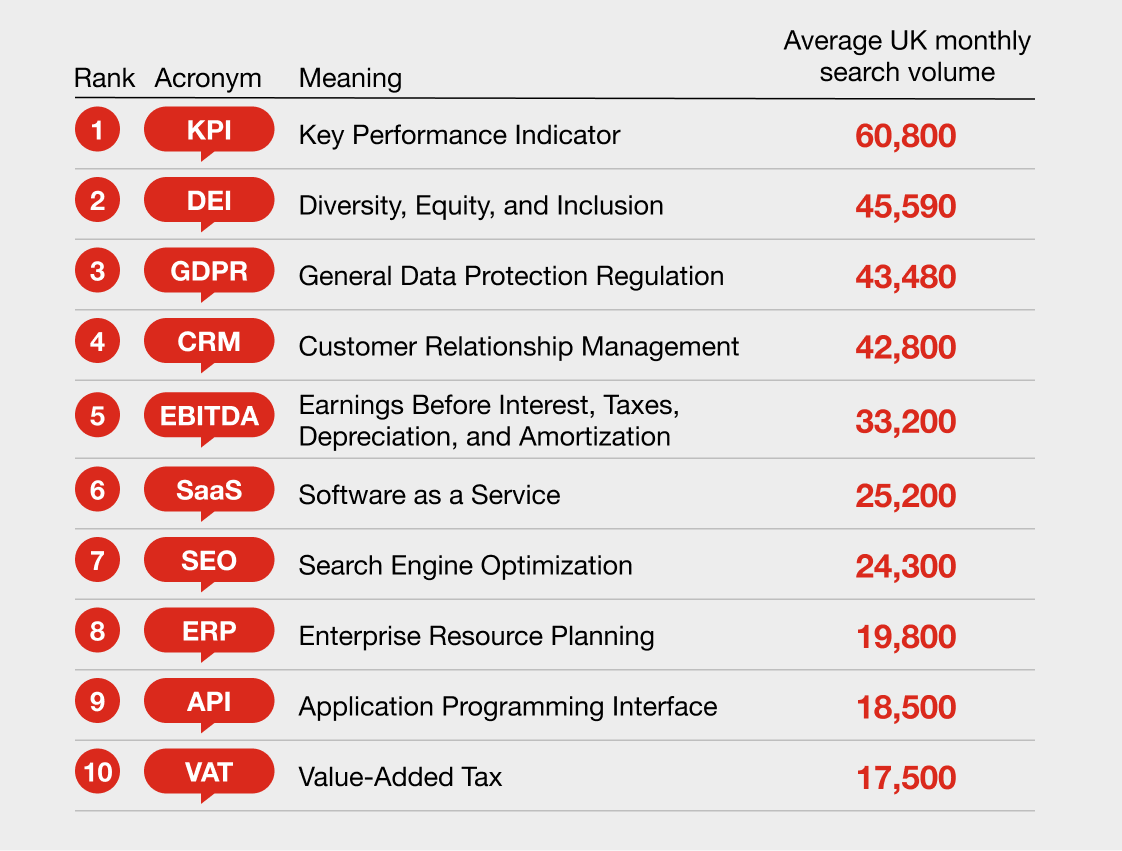
The most searched business acronyms in the UK are:
- KPI – 60,800 searches per month
- DEI – 45,590 searches per month
- GDPR – 43,480 searches per month
- CRM – 42,800 searches per month
- EBITDA – 33,200 searches per month
- SaaS – 25,200 searches per month
- SEO – 24,300 searches per month
- ERP – 19,800 searches per month
- API – 18,500 searches per month
- VAT – 17,500 searches per month
Based on UK search data, these business acronyms generate the highest levels of online interest, suggesting they are the terms people most frequently look up.
Below, we break down each acronym in plain English, explaining what they mean and why they matter to entrepreneurs.
1. KPI – Key Performance Indicator
UK Searches: 60,800 per month
A Key Performance Indicator, or KPI, is a measurable value that shows how your business is progressing towards its objectives2 (external link). KPIs vary from industry to industry, and from business to business.
They provide direction and focus, helping owners and managers to prioritise tasks, allocate resources, and evaluate outcomes.
A study (external link) found that KPIs related to productivity, cost management, and quality control can improve operational efficiency and give your business a competitive advantage.
2. DEI - Diversity, Equity, and Inclusion
UK searches: 45,590 per month
Diversity, Equity, and Inclusion (DEI) is a framework for promoting equal rights and treatment within the workplace3 (external link).
Beyond social responsibility, DEI is a strategy that can increase innovation and creativity, enhance talent acquisition and retention, and improve financial performance in the long-term4 (external link).
Allyship, intersectionality, psychological safety, and microaggressions are just some of the concepts that entrepreneurs should familiarise themselves with when thinking about their company culture.
3. GDPR - General Data Protection Regulation
UK searches: 43,480 per month
General Data Protection Regulation (GDPR) governs how businesses protect people’s personal data5 (external link). It is a legal act which applies across all of Europe, although there are nuances in each individual country.
Here in the UK, business owners should ensure that they are handling personal data responsibly and adhering to the data protection principles. (external link)
While a small business may be handling a smaller volume of data, you still need the necessary processes in place to protect people’s data. Creating a GDPR compliance checklist can help you to make sure that your policies are following best practices.
Read our guide to GDPR for small businesses for more information.
4. CRM – Customer Relationship Management
UK searches: 42,800 per month
A Customer Relationship Management (CRM) system is a software which centralises information about customers and prospects. It can be used to manage, automate, and analyse interactions6 (external link).
There are three main types of CRM:
- An operational CRM which combines sales, marketing, and service tasks.
- An analytical CRM which analyses user data, including customer behaviours and trends.
- A collaborative CRM which allows stakeholders and vendors to work together.
When selecting a CRM, consider the features that are most important for your business.
5. EBITDA - Earnings Before Interest, Taxes, Depreciation, and Amortisation
UK searches: 33,200 per month
Earnings Before Interest, Tax, Depreciation, and Amortisation (EBITDA) refers to a company’s profit for a given period. It is the total before the subtraction of interest, taxes, and reductions in asset value7 (external link).
If a business has a positive EBITDA, it is making more money than it is spending on its basic operations. If the EBITDA is negative, the company’s operating costs are higher than the money it’s bringing in.
To learn more about EBITDA, check out our Hiscox Explains: EBITDA video.
6. SaaS - Software as a Service
UK searches: 25,200 per month
Software as a Service (SaaS) is a software that you access over the internet rather than installing it on your device. The provider builds, owns, and runs the application for you8 (external link).
SaaS can be used for accounting, Customer Relationship Management, team collaboration, and project management. It typically operates on a monthly or yearly subscription model.
7. SEO - Search Engine Optimisation
UK searches: 24,300 per month
Search Engine Optimisation (SEO) is the practice of improving how easily your website can be found on search engines like Google. The closer you appear to the top of the Search Engine Results Page (SERP), the more like you are to attract organic traffic9 (external link).
There are three main kinds of SEO:
- On-page SEO, which focuses on what is on your website.
- Technical SEO, which makes sure that your website works properly.
- Local SEO, which helps your business appear in local search results.
- Off-page SEO, which builds trust and authority in key publications.
8. ERP - Enterprise Resource Planning
UK searches: 19,800 per month
Enterprise Resource Planning (ERP) is a software system that manages all of a company’s information and day-to-day activities by bringing everything together into one shared data source10 (external link).
It allows different departments to work from the same information, with the aim of improving coordination and efficiency across the business
9. API - Application Programming Interface
UK searches: 18,500 per month
Application Programming Interface (API) is the way that different software systems communicate. For example, an e-commerce platform might use an API to process payments through a third-party provider11 (external link).
API’s can be useful for businesses which rely on multiple digital platforms, or want to integrate new services quickly.
10. VAT - Value-Added Tax
UK searches: 17,500 per month
Value Added Tax (VAT) is a sales tax applied to eligible goods and services in the UK12 (external link).
Businesses have to register for VAT (external link) if their turnover is more than £90,000. If registered, you should keep clear records, submit quarterly VAT returns, and pay any VAT due to His Majesty’s Revenue and Customs (HMRC).
If you’re not sure where to start, our blog on how to register for VAT could be a good read for you.
Industry scoop
Clare March (external link), founder of Her Business Counts (external link), says: ‘In my experience working with women running micro-businesses, the ones that cause the most confusion are VAT, PAYE, SA, and MTD. These aren't obscure terms, they're things my clients encounter regularly, but the way they're presented can make them feel completely inaccessible.
‘It’s not even really the acronym itself. I can tell you VAT stands for Value Added Tax but does that make it any clearer? Probably not. What you need is someone to explain what it means for your business, and to help you make choices where they are available to you.
‘If you don't know what VAT means for your cash flow, you can make decisions that look fine on the surface but quietly put you in a really difficult position. For micro-business owners especially, there's no finance team to catch those gaps; it's just you.
‘I always say to my clients: you don't need to become an accountant, but you do need to feel confident enough to ask the right questions and understand the answers.
Why do business acronyms matter?
Understanding business acronyms isn’t just about sounding knowledgeable. Many acronyms represent core concepts that shape how businesses operate, communicate, and grow.
They influence real-world decisions, from financial planning to compliance, and even affect the choices business owners make about essential protections such as business insurance.
Knowing these business terms can help to improve decision-making, support clearer communication, reduce costly misunderstandings, and drive business performance.
As business language continues to evolve, understanding these terms is a smart decision for new and aspiring entrepreneurs.
How business owners feel about unfamiliar terminology
Encountering unfamiliar business terminology can trigger a mix of emotions.
More than one in six (16%) business owners feel frustrated when they encounter an unfamiliar term, according to our survey. They also reported feeling intimidated (13%), and overwhelmed (12%).
However, sentiment isn’t entirely negative. In fact, over two-fifths (41%) feel curious when they come across new acronyms.
Industry scoop
Max Fellows (external link), Founder of growth specialists allpoints (external link) and global mentoring programme Elevate (external link), says: ‘New founders can struggle with business terminology and it is completely natural. The reality of starting your first business is that a lot of this is new territory and the first time you would be using that type of language.
‘Many founders have come from senior roles within an industry, so they understand the sector well and some language associated with running a budget, but not necessarily the language of running a business. Others start up founders spot a gap in the market and go for it, which often means they are learning both the industry and the commercial terminology at the same time.
‘In both cases there is a learning curve. Running a business exposes you very quickly to finance, legal, investment and operational language that you may not have needed before. And that is ok, you are not expected to know it all immediately but depending on the state of your start up and the size of the investment, that will come with some expectations.’
Where do business owners learn business terminology?
When business owners need to decode an acronym or unfamiliar term, Google is by far the most common source of information, with 69% turning to search engines first.
Social media provides another opportunity for learning, with 16% using platforms such as TikTok or LinkedIn for bite-sized business explanations. On TikTok, there are more than 1.5 million videos under the #businesstips hashtags, as creators turn to short-form educational content.
Meanwhile, 15% of business owners use AI tools to help them interpret unfamiliar concepts. Platforms such as ChatGPT and Perplexity play a growing role in real-time learning, although should be used with caution.
Beyond digital channels, many entrepreneurs continue to rely on more traditional resources:
- 13% turn to online courses or webinars
- 12% use books
- 11% lean on group chats or community forums
- 11% seek guidance from business coaches
- 10% read business magazines
This mix of formal and informal learning suggests that entrepreneurs do not rely on a single source of information. Instead they build their knowledge through a blend of quick definitions, expert advice, community insight, and long-form content.
Practical tips for mastering the language of business
Learning and understanding new business terms can be a long process, especially when doing so alongside building or running a business.
Jonathan Cooper, Founder and Director of The Director’s Helpline (external link), shares four practical steps for learning new terms:
1. Learn the language before you open the doors: ‘Don't wait until your business is live to start understanding terms like cash flow, P&L, or EBITDA. Spend time before launch getting familiar with the basics - even a few hours reading guides from established sources can save you from costly mistakes down the line. Think of it like learning to drive before buying a car.’
2. Use free resources from trusted organisations: ‘You don't need to pay for a business course to get started. Banks, accountancy software providers (such as Xero or QuickBooks), HMRC, and industry bodies all publish free, practical guidance for new business owners. Sites like MoneySavingExpert also cover the financial basics in plain English.’
3. Join a business forum and ask the 'obvious' questions: ‘Online business communities are full of people who've been exactly where first-time business owners are. Forums and groups (such as those on Reddit, LinkedIn, or dedicated small business networks) are brilliant for demystifying jargon in a judgement-free space. No question is too basic, chances are someone else is wondering the same thing.’
4. Accept that there's no single manual - so build your own: ‘Every business is different, and no one resource covers everything. The most effective new owners treat learning as an ongoing habit: saving useful articles, noting down terms to look up, and revisiting the fundamentals as their business grows. A simple notes document or folder of bookmarked resources becomes your personalised handbook over time.’
Methodology
We surveyed 350 UK business owners and directors in March 2026 via OnePulse to understand their confidence levels when encountering business terminology, as well as the sources they use to learn new concepts.
To identify the most confusing business acronyms, we analysed over 500 common business terms, examining monthly UK Google search volumes for queries including ‘[term] definition’, ‘what is [term]’, and ‘[term] meaning’.
These search volumes were combined and ranked to identify the 10 most searched acronyms, highlighting the business terms UK entrepreneurs most frequently look up.
Notes
The views of the experts cited are not the views of Hiscox.
Hiscox is a specialist insurance company that offers a diverse range of business insurance products. Find information on our business insurance products, including public liability and professional indemnity.
Disclaimer:
At Hiscox, we want to help your small business thrive. Our blog has many articles you may find relevant and useful as your business grows. But these articles aren’t professional advice. So, to find out more on a subject we cover here, please seek professional assistance.
References
- https://www.gov.uk/government/statistics/business-population-estimates-2025
- https://dictionary.cambridge.org/dictionary/english/kpi
- https://dictionary.cambridge.org/dictionary/english/dei?q=DEI
- https://www.lse.ac.uk/news/latest-news-from-lse/k-november-2024/diversity-equity-and-inclusion-not-bad-for-business
- https://dictionary.cambridge.org/dictionary/english/gdpr?q=GDPR
- https://dictionary.cambridge.org/dictionary/english/customer-relationship-management
- https://dictionary.cambridge.org/dictionary/english/ebitda?q=EBITDA
- https://www.dictionary.com/browse/saas
- https://dictionary.cambridge.org/dictionary/english/search-engine-optimization
- https://dictionary.cambridge.org/dictionary/english/enterprise-resource-planning
- https://dictionary.cambridge.org/dictionary/english/api
- https://dictionary.cambridge.org/dictionary/english/vat?q=VAT
Related articles and guides