

Britain’s appetite for artisan bread, neighbourhood bakeries, and high-quality baked goods shows little sign of slowing. From sourdough loaves and flaky pastries to regional specialities, bakery businesses are thriving across the UK, with UK Google searches for ‘bakery near me’ rising 50% year-on-year to an average of 368,000 per month.
To map out where independent bakeries are thriving, we analysed OpenStreetMap data alongside UK search data, uncovering where consumer demand is strongest and where gaps may still exist in the market.
To explore what that growth can look like for business owners, we spoke with Birgit Gunz, founder of independent business, Frankonia Bakery (external link). She shares how her business has evolved over nearly three decades to meet changing demand, along with her advice for bakery owners looking to scale.
The UK cities leading the way for independent bakeries
To identify the UK cities leading the way for independent bakeries, we analysed bakery locations and calculated the number of independent bakeries per 100,000 residents in each city. Independent bakeries were identified using OpenStreetMap bakery data, excluding locations matched to known bakery chains (e.g. Greggs, Gail’s, Wenzel). OpenStreetMap is a map database which uses aerial imagery, GPS devices and field mapping to keep its data accurate and up to date.
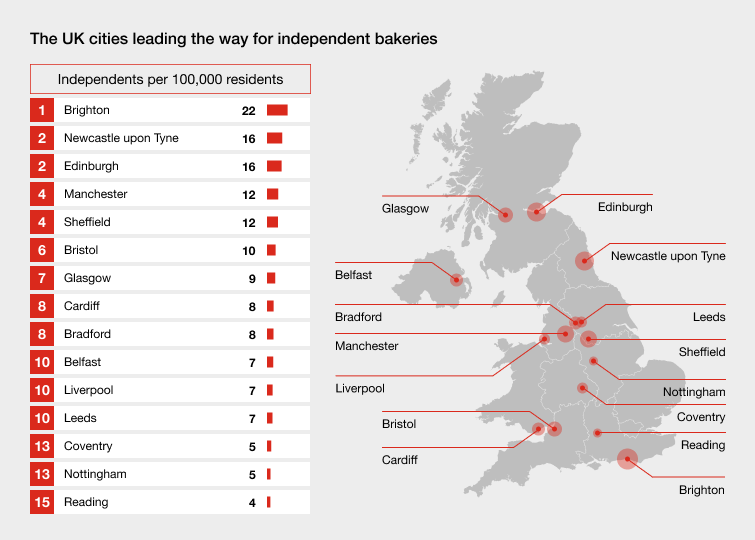
Brighton tops the list with 22 independent bakeries per 100,000 people, followed by Newcastle upon Tyne (16) and Edinburgh (16).
Manchester, Sheffield, and Bristol also rank highly, suggesting that strong demand for independent bakeries is not limited to one part of the UK.
For bakery owners, a high density of independent stores may suggest that customer demand is already strong, but it can also make it harder to stand out and attract loyal local customers.
UK cities where demand for bakeries is strongest
While the number of independent bakeries shows where they are already well established, demand highlights where consumer interest appears to be strongest. To create a demand score, we analysed city-level search data for bakery-related terms and adjusted it for population size.
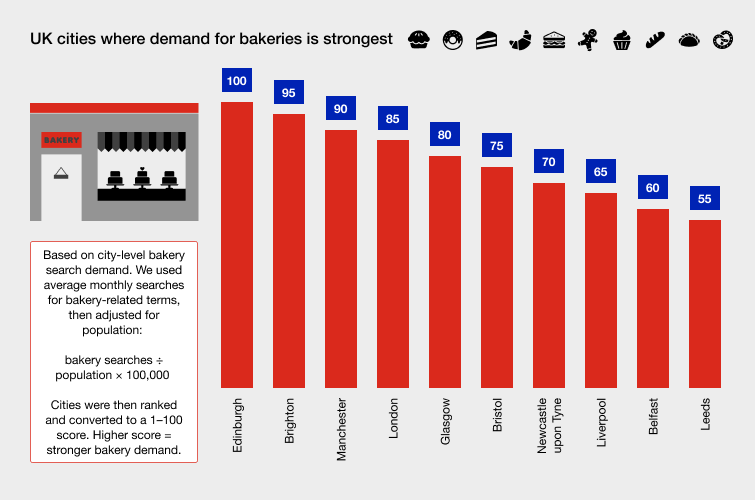
Edinburgh comes out on top with a demand score of 100, followed closely by Brighton (95) and Manchester (90). London, despite its size and already crowded food scene, ranks fourth with a score of 85, while Glasgow and Bristol also show strong demand.
Some cities appear in both the highest-density and highest-demand rankings. Edinburgh, Brighton, Manchester, and Newcastle upon Tyne all feature strongly across both lists, which may not only indicate well-established independent bakery scenes, but also sustained interest from consumers.
The two rankings show that strong consumer interest is not limited to cities where independent bakeries are less established. In several locations, high bakery density sits alongside high demand scores, suggesting that consumer interest remains strong even in more developed bakery markets.
UK cities with a bakery supply gap
As well as showing where bakeries are already concentrated and where interest is strongest, the data also highlights cities where bakery supply may be relatively limited for the size of the local population. To estimate this, we compared how many bakeries each city, using OpenStreetMap data, against population size to identify a supply gap score.
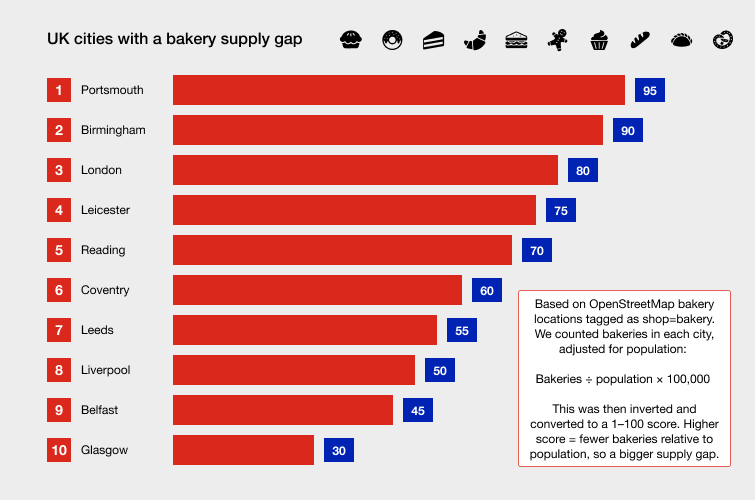
Portsmouth ranks the highest with a score of 95, followed by Birmingham (90) and London (80). In these cities, the number of bakeries appears relatively low compared with population size.
Leicester, Reading, Coventry, and Leeds also appear in the rankings, indicating a similar pattern of lower bakery density relative to local population.
However, a supply gap on its own does not guarantee success. Business owners still need to consider practical factors such as rent, staffing, footfall, and logistics. They will also need to account for competition from larger chains and supermarkets, and whether the business can maintain quality and consistency as it grows – in some cases, it may also be sensible to seek relevant professional advice.
How one bakery owner experienced a boom

For Birgit Gunz, founder of Frankonia Bakery and sourdough brand The Bread Queen, growth has come from adapting to demand carefully and strategically.
Birgit says: ‘I founded Frankonia Bakery in 1998 as a high street bakery in Wimbledon Village to meet an emerging demand for high-quality artisan bread and European-style sourdoughs.
‘Since then, we have evolved into a wholesale bakery supplying the 5-star hospitality sector in Central London and the UK. We met demand that had been rising ever since we first started making bread and pivoted to a sector where we saw advantageous growth.’
Birgit believes several factors have driven the recent strength of the bakery space. She says:
‘Within the retail sector, I believe the rising demand for sourdough and ‘real’ (no additives) bread is driven by consumers wanting a healthier lifestyle and better diet.
‘I’ve noticed that this trend is extraordinarily strong in the younger generation (20–30-year-olds) who are proving to be most health conscious, setting priorities on a healthy lifestyle instead of possessions.’
Why growth is not always about getting bigger
Although Frankonia Bakery has experienced significant growth across hospitality and retail, Birgit is clear that more demand does not automatically mean expansion is the right move.
‘We have seen significant growth within the hospitality sector, as well as rising demand for sourdough within the retail sector. This could have been ample reason to increase staffing levels, and expansion to a larger site would have been imminent, but I chose to take another route,’ she says.
‘I decided to streamline our production, moving away from such a broad range of products and streamlining our customer base. This freed up capacity and space as well as increasing profit margins.’
Rather than opening multiple sites, Birgit chose a route that kept operations under one roof and gave the business more control over cost and consistency.
‘Since the pandemic, shopping behaviour has changed, in that consumers tend to buy much more online,’ she says. ‘Sourdough has also become exceptionally popular with consumers and demand is constantly rising – not just in cities but also in rural areas where real sourdough is much harder to come by.’
This led to the launch of The Bread Queen, an e-commerce platform that sells part-baked, finish-at-home sourdough products directly to consumers nationwide.
The hidden pressures behind a bakery’ growth period
From the outside, a growing bakery can look like a straightforward success story: more orders, more customers, more visibility. But Birgit says the pressure behind the scenes can be significant.
According to Birgit, one of the biggest operational strains is logistics.
‘Logistics can come under heavy pressure. What works when handling smaller order volumes may not work at scale. It is important to examine how established processes will work with higher volumes before they fail. Being proactive and not reactive is essential,’ she says.
Birgit says another consistent challenge she's seen throughout nearly three decades in business is finding the right staff:
‘Staffing can also be challenging. Not all jobs in an artisan bakery can be done by machines. It is still very much a craft business. Skilled bakers are very difficult to find, as are staff who can fill other positions and work at unsociable hours. The job market has become exceptionally tight in the last decade.
‘The biggest challenge is not only to find staff who are highly skilled but to keep them motivated. They need to feel part of the collective and be part of something that increases their self-worth, whilst providing them with a happy working environment, fair pay and recognition for their work.
‘Cash flows can also come under intense pressure and are very much down to how much capital is available to fund expansion.’
How bakeries can navigate a growth period
Birgit’s advice for bakery owners
1. Don’t assume that more sales mean a better business
A bakery can be busier but not make more profit. Factors such as healthy margins, product quality and service standards can all be important factors as a business grows.
‘Expansion is a double-edged sword, and I honestly believe that growth and expansion cannot be viewed as increased sales alone. As tempting as it might be, it only makes sense if the right profit margins can be met – without compromise,’ says Birgit.
‘Never let go of standards. Remember why customers bought your products to begin with.’
2. Be cautious about taking on debt
Expanding your business often means spending money, but borrowing too much can put you under pressure if things don’t go to plan.
‘Meeting demand and expansion require capital. If this can only be funded by raising finance, it is important not to overextend. Debt can be precarious. The risk-reward ratio needs to be carefully weighed up. In my experience, it pays off to be a little conservative,’ says Birgit.
3. Plan ahead operationally
As your business grows, things like staffing, equipment, and systems need to keep up. It can be easier to handle increased demand if you’ve planned for it in advance – particularly in cases where demand rises quickly or unexpectedly.
‘We have adapted by constantly reviewing and improving operations and systems, including I.T., to make them as efficient as possible. By maximising the use of Electronic Data Interchange (EDI) (external link), we have been able to increase the capacity of admin personnel. This was and still is a crucial factor,’ says Birgit
‘We also invested in equipment, such as ovens, which not only increased capacity but also gave us room to develop and grow into. Installations are disruptive as well as expensive, and it is not advisable to go through this frequently. Therefore, it is important to look ahead when planning.’
Disclaimer:
This is general information only and should not be taken as advice. Businesses should seek independent professional advice based on their own circumstances.
Why resilience matters as bakeries grow
‘Periods of growth can be exciting for small food businesses, but they can also put real pressure on day-to-day operations. For bakery owners, success often brings new challenges around staffing, equipment, stock, supply chains, and cash flow — all of which need careful planning if growth is going to be sustainable.
‘The businesses that tend to navigate growth best are the ones that look beyond demand alone and think about resilience, too. That means understanding where the risks are that could impact operations, cashflow or reputation, and making sure the right protections are in place as the business evolves.’ - Nick Thornhill, Direct and Partnerships Director at Hiscox UK
Hiscox offers specialist business insurance, such as protecting your precious baking equipment with business contents cover or guarding against personal injury with public liability insurance. You can explore our business insurance for bakers to see how we can support your business as it grows.
Methodology
We identified UK bakery opportunities by comparing UK Google search demand with the current bakery supply.
Independent bakeries were identified using OpenStreetMap bakery data, excluding locations matched to known bakery chains (e.g. Greggs, Gail’s, Wenzel). We used OpenStreetMap because it provides structured location data that can be compared consistently across UK cities.
Independent bakeries per 100,000 residents were calculated using the number of bakeries classified as probable independents within each city, adjusted for population size: (Independent bakery count ÷ population) × 100,000.
Higher values indicate a denser independent bakery market relative to the size of the local population.
Demand score
Based on city-level bakery search demand e.g. ‘bakery near me’. We used average monthly searches for bakery-related terms, then adjusted for population:
Bakery searches ÷ population × 100,000
Cities were then ranked and converted to a 1–100 score. A higher score meant a stronger bakery demand.
Supply gap score
Based on OpenStreetMap bakery locations tagged as shop=bakery. We counted bakeries in each city, adjusted for population:
Bakeries ÷ population × 100,000
This was then converted into a score from 1 to 100. A higher score meant fewer bakeries relative to population, indicating a bigger supply gap.
Related articles and guides