

Late Payments Report: The impact on sole traders and small businesses
.
9
min read
Running your own business often means wearing multiple hats. From marketer to product developer to chief financial officer, the list can be exhilarating and non-exhaustive. Chasing late payments, however, can be one of the less desirable roles.
Late payments are one of the most stressful challenges facing small businesses. They can hinder growth and be a cash flow nightmare for businesses, constantly chasing invoices and feeling financial strain. In the worst cases, they can threaten the survival of a business entirely.
The scale of the problem has become so marked that the government announced a new Fair Payment Code (external link) in late 2024, revealing refreshed rules to tackle late payments. It said it will hold companies to further account and mandate large businesses to include payment reporting in their annual reports.
To reveal just how much is owed in late payments, we surveyed 1,000 sole traders, small business owners, and directors with knowledge of the business’s finances. We enquired if they view late payments as their biggest cashflow issue, how many invoices they’re chasing, and how they try to avoid late payments. Nick Thornhill, Direct and Partnerships Director at Hiscox, shares insights on small steps you can take to reduce the risk and impact of late payments should invoices go unpaid.
See our insights in an interactive visualisation below and read on to hear from real small business owners.
Small businesses consider late payments their biggest cashflow issue
According to the Department for Business and Trade (external link), in 2024 there were 5.45 million small businesses with 0 to 49 employees, which accounted for 99.2% of the UK’s total business population.
Amidst a backdrop of high business costs, unpredictable income, and cyber attacks, among other challenges, small business owners and directors stated that late payments were the most problematic issue for cash flow. Late payments received 58% of the vote.
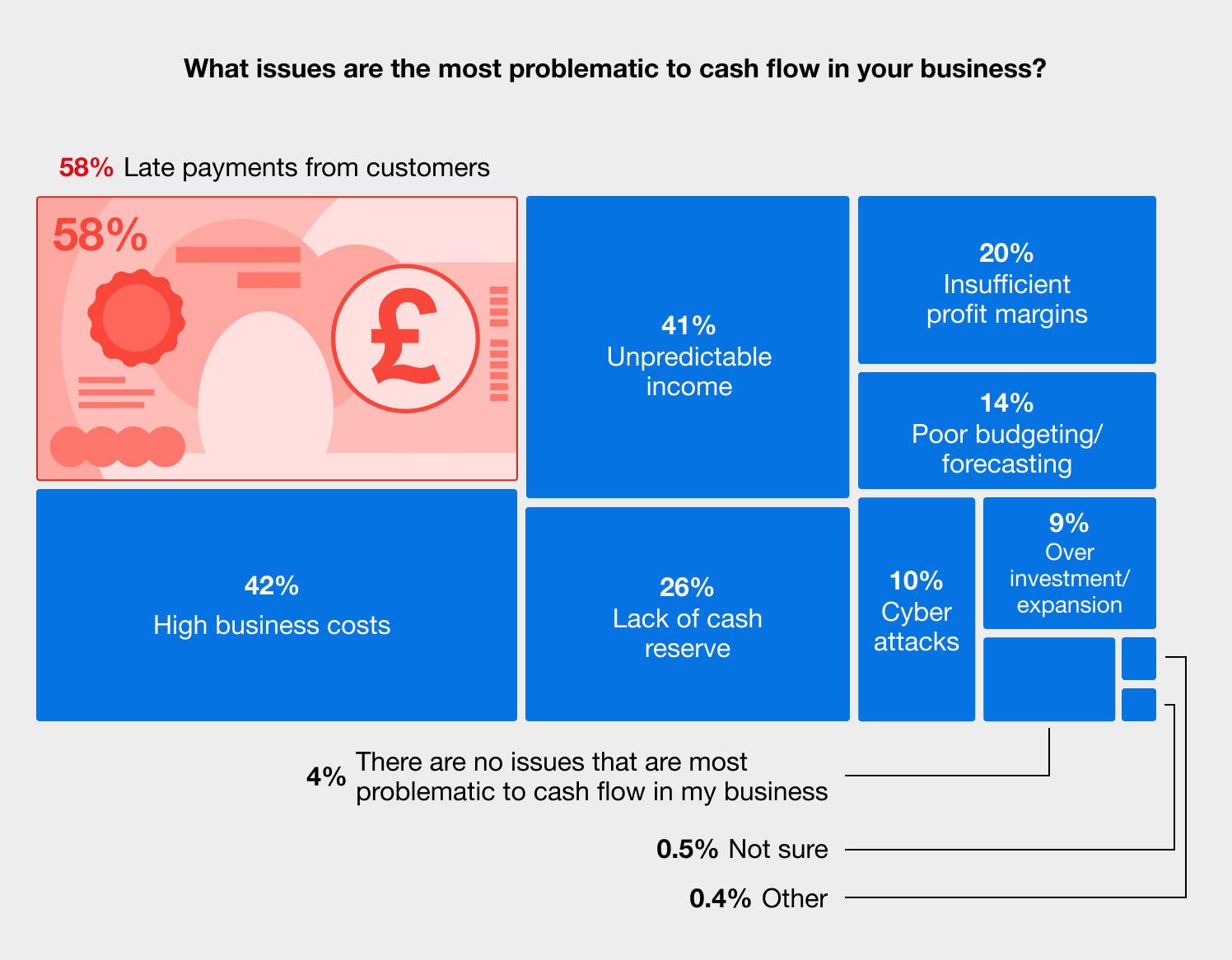
For small businesses with between 10 and 49 employees, this figure rose to 63%, compared to 46% among sole traders. This suggests that late payments become a more significant issue as the business grows.
Architecture, engineering and building companies considered it more problematic (68%), and HR firms less so (31%). Small businesses in Plymouth relayed the highest figure (69%), and Belfast the smallest (36%).
One in five business payments are late
Most respondents are currently chasing between 10-20 late payments (37%). Considering the 5.45 million small businesses in the UK, that could mean as many as 109 million invoices are being chased right now. When asked what proportion of payments are late from clients, most respondents said as many as one in five (20% of invoices) aren’t paid on time (36% of the vote). Nearly a quarter (24%), however, said it’s more: as much as 30% of payments require chasing.
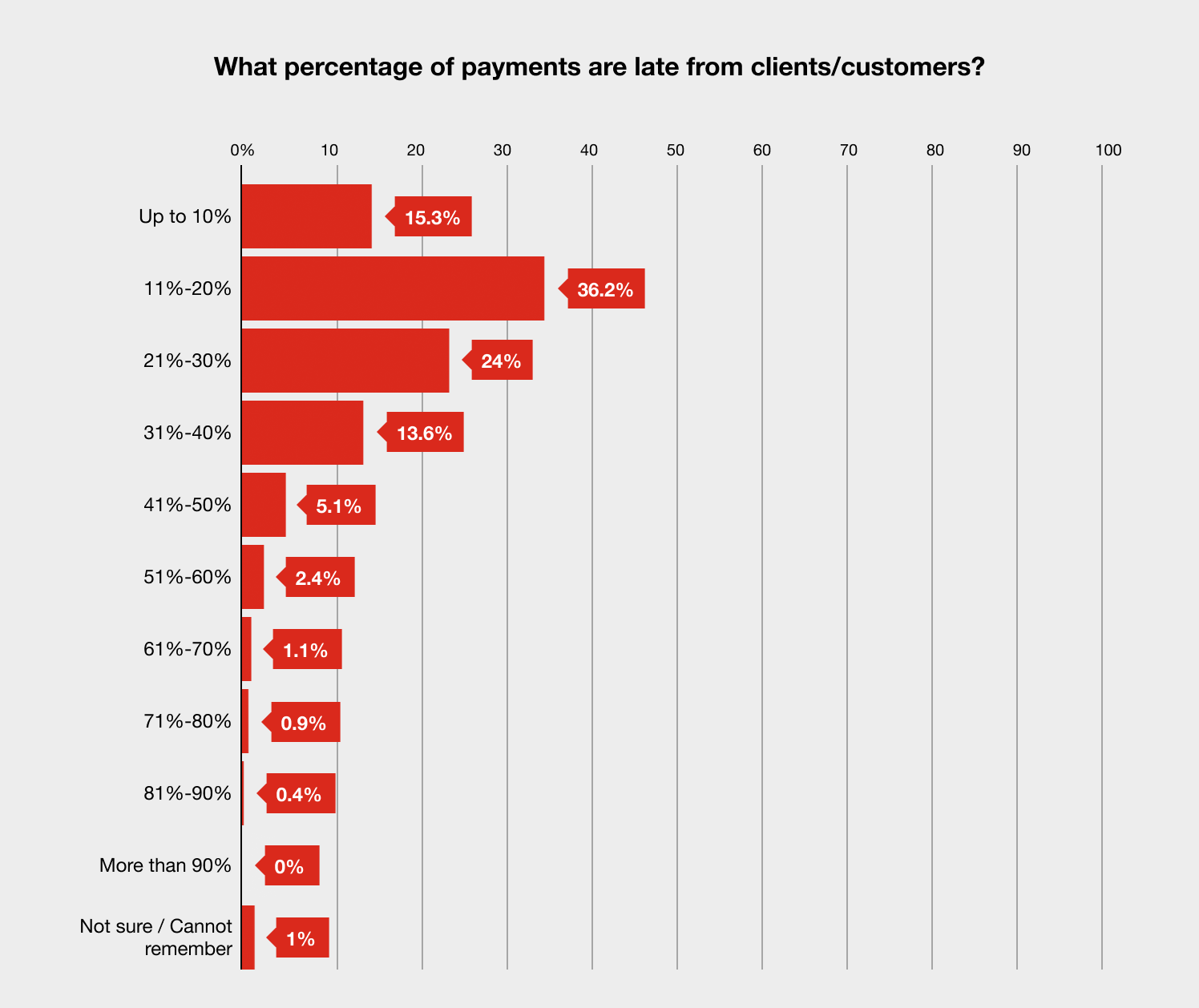
Each industry echoed one another, saying up to one in five payments are late, apart from HR, which reported up to 30% are late.
Most small businesses are chasing £400 per late payment
Revealing how out of pocket they’re left each time, close to half (44% for businesses with 10 to 49 employees) said each unpaid invoice was worth between £201-£1,000. The results, however, were tightly drawn up to £1,000, illustrating just how broad the value of each invoice can be.
A more detailed analysis of the results can be found in the chart below.
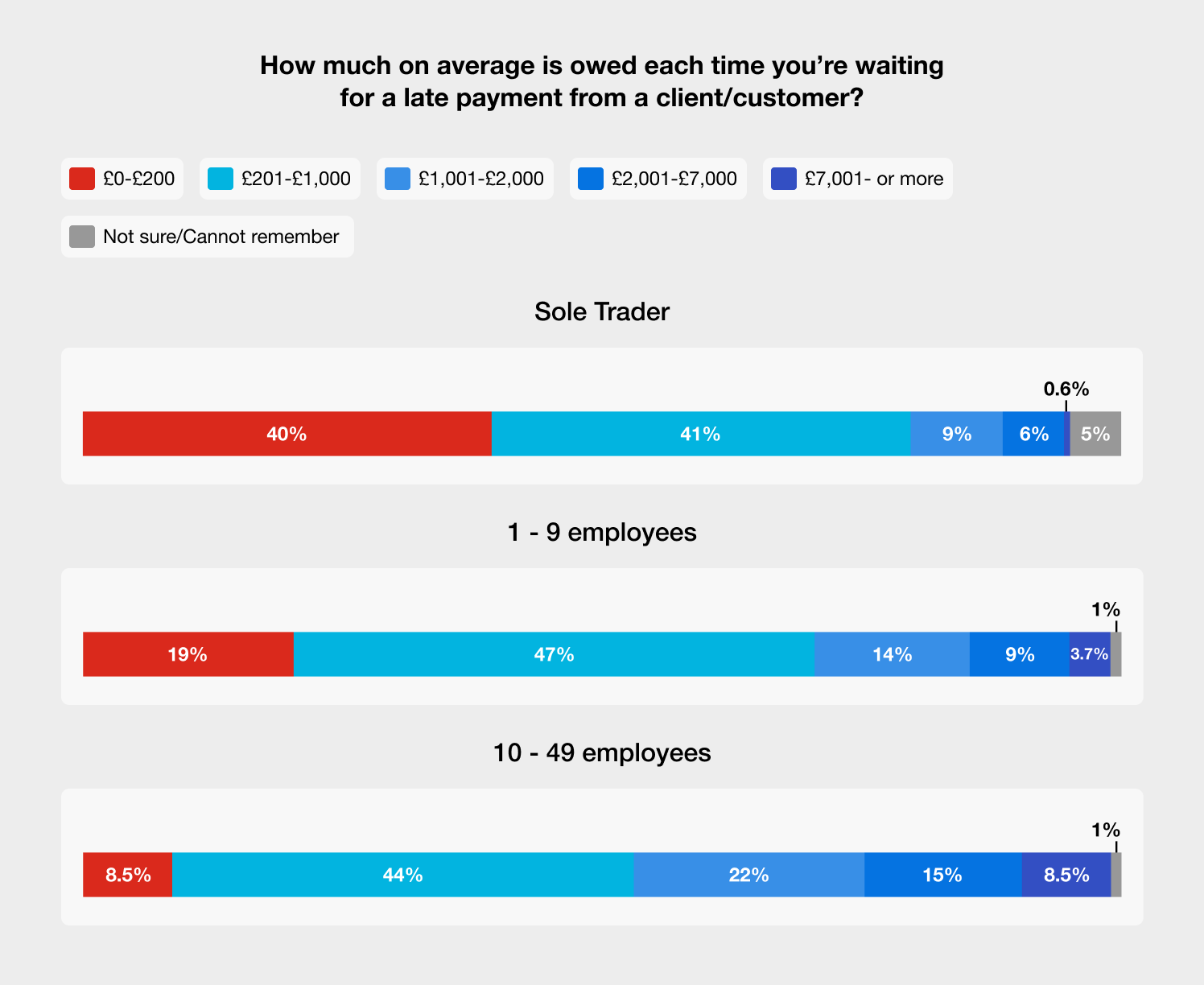
When comparing by company size, the results suggest that as a business grows from a sole trader to up to 49 employees, so does the number of late payments, and the average amount owed per invoice.
Most small businesses estimated that they spend up to two hours a month chasing these late payments.
Small businesses are owed up to £10,000 a year in late payments
Most (37% for businesses with 10 to 49 employees) estimated their businesses were owed between £1,001-£10,000 each year in late payments. That could be as much as £27.3 to £54.5 billion missing each year in late payments across the UK.
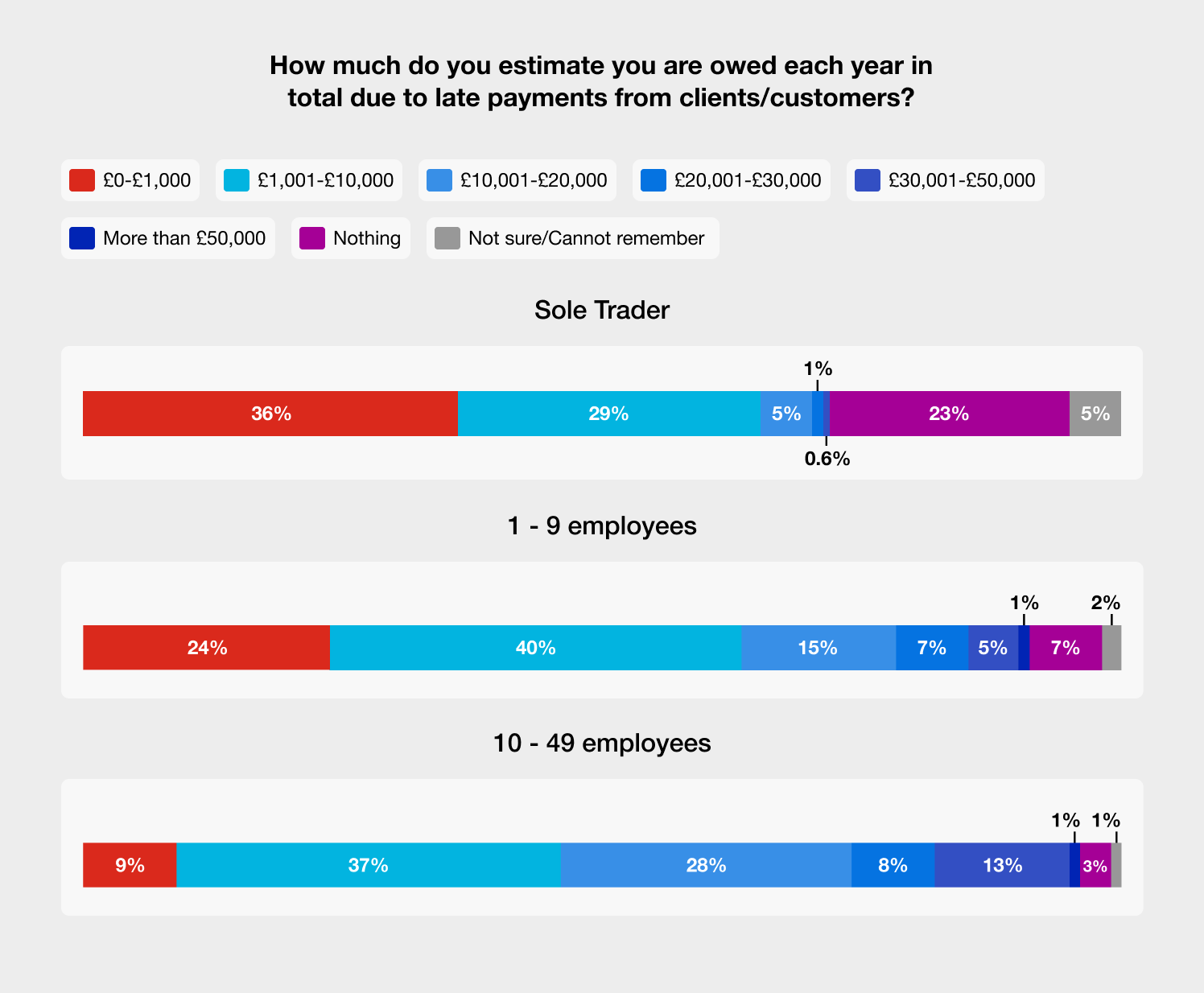
Sole traders were most able to settle late payments, as almost a quarter (23%) weren’t owed anything by the end of the year. This figure declined as the company size increased, with small businesses employing up to 49 staff having the lowest settlement rate at 3%.
Similarly, the total amount owed at the end of each year grew with company size. Sole traders with missing payments were most likely to be out of pocket by up to £1,000 (36%), while businesses with up to 9 employees were most likely to be missing up to £10,000. For those with up to 49 employees, the number of businesses missing between £10,001 and £20,000 grew significantly and reached 28%.
“There’s always the fear someone won’t pay up”
One small business owner who wished to remain anonymous shared their story of worry, stress, and relying on credit cards because of late payments:
“There’s always the fear that someone won’t pay up. I’ve had it only twice in nine years where an invoice hasn’t been paid at all. The first time it happened, they were my only client, and it meant I had no money for two months.
“Working for yourself is a joy. It’s the best. But when people don’t pay up, it not only throws your finances into issues, but it also affects your confidence and piles on stress. It means you always need money set aside for worst-case scenarios.”
Nine years later, they reveal they’re still battling late payments:
“Now, we have a couple of clients that always pay on time, but out of the five we work with, three always need to be chased.
“It’s meant that at times I’ve missed my credit card payments, and that can affect my credit rating. It’s another issue you have to deal with on top of a busy work schedule.
“I now have someone I pay to chase my invoices to take that pressure off me, but it’s still always there.”
What would they say to companies that pay late?
“If the money is in your bank - pay it. Remove the worry for the other person, and for yourself. Whatever happens, you’ve paid the people that matter - the people who work for you and support your business.”
Most small businesses receive a late payment up to two weeks late
Almost a third (30%) said they typically receive a late payment two weeks after its due date. Compared to other cities, Glasgow and Newcastle reported the longest average wait time of up to one month.
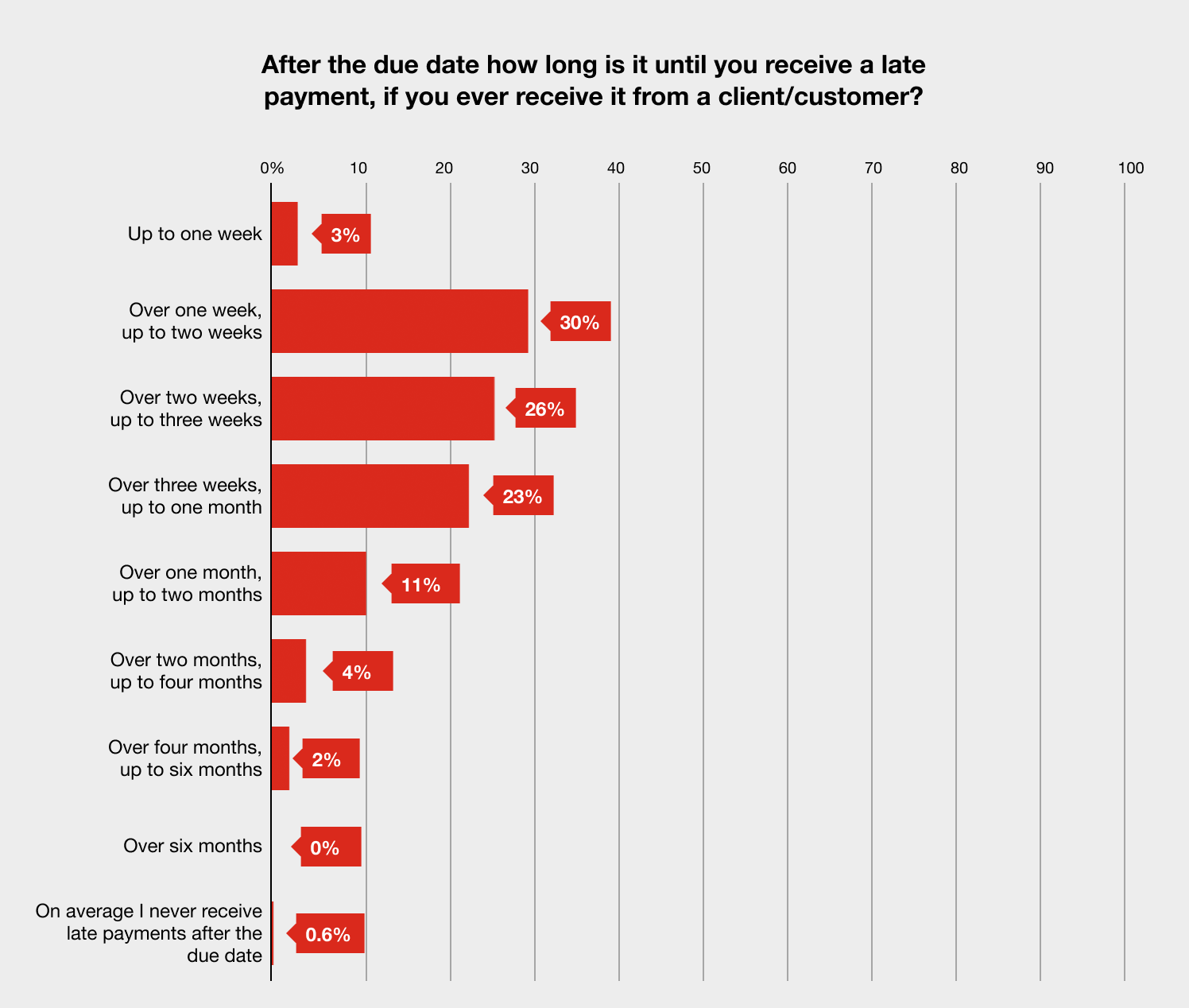
Similarly to other insights, the bigger the company, the longer the wait time. Most companies with up to 49 employees reported receiving payments up to three weeks late, compared to sole traders, who said payments were late by up to two weeks.
Small businesses primarily send payment reminders when chasing late payments, but one small business owner shares his simple tips to prevent the chase
The number one tactic small businesses use to chase late payments is sending payment reminders (48% do so). Some pursue stronger action: Over a quarter (28%) charge late payment fees, and 29% withhold other pending goods or services until the late payment is received. Some (15%) also prefer a direct approach and arrange a face-to-face meeting, and 6% said they post about it on their social media account to generate attention.
Richard Stone, founder and managing director of small PR agency Stone Junction, was all too familiar with late payments in his early days:
"Late payments are probably the biggest challenge a small business faces, not just because they hit cash flow, but because they create uncertainty. You’re delivering work on time, and then suddenly you're chasing money that’s 30, 60, even 90 days overdue. It can undermine your ability to plan for the future or invest in the business.”

But he says the good news is there are some ways to help mitigate late payments:
"We’ve found that honest, consistent communication with clients is the single most effective strategy. Building strong relationships with both your main contact and the accounts team makes a real difference.”
When we asked what business owners do to help prevent late payments, 36% echoed Richard’s sentiment, saying they build strong relationships to encourage timely payment, and they’re very clear with their payment terms ahead of accepting new business. Richard adds:
"There are also practical steps that help. One trick is to issue invoices at the very end of the month rather than the beginning. This sounds small, but it can stop you being kicked into the next payment cycle. We also always clarify terms upfront, chase promptly, and never assume silence means payment is on the way.
"Ultimately, getting paid on time isn’t just about process, it’s about people. Be professional, be clear, and be proactive."
The vast majority of small businesses feel optimistic about the government’s Fair Payment Code
The new Fair Payment Code replaces the Prompt Payment Code, aiming to encourage quicker payment practices. It was introduced in January 2025 and is enforced by The Small Business Commissioner (external link) (OSBC), which is an independent public body that tackles late payments and unfavourable payment practices in the private sector.
Our research found 62% of small businesses feel optimistic about this update, and only 12% feel pessimistic.
The refreshed system scores and awards businesses based on the promptness of their business payments:
- A Gold Award goes to companies who pay at least 95% of their suppliers within 30 days
- A Silver Award goes to companies who pay at least 95% of their suppliers within 60 days, but they must pay at least 95% of their small business suppliers within 30 days
- A Bronze Award goes to companies who pay at least 95% of their suppliers within 60 days
This award lasts for two years, and businesses must reapply for their award after this time. You can view a company’s award status on the OSBC here (external link).
Nick Thornhill provides small tips on how to cope with late payments
Nick Thornhill, Direct and Partnerships Director at Hiscox, explains:
“As a small business insurer, we know that cash flow is the lifeblood of any business. Yet, late payments remain one of the biggest challenges for entrepreneurs and SMEs. Knock on effects of late payments can disrupt cash flow, impact payroll, delay investment, and seriously compromise a business.
“Here are some practical small steps small businesses can take to reduce the risk and impact of late payments:
- Be quick to invoice- Send invoices as soon as the job’s done. A late invoice could be seen as an open invitation for a late payment.
- Keep it friendly- Most of the time, people aren’t paying late on purpose. A quick, cheerful reminder can go a long way. But if late payments keep piling up, don’t be afraid to address them.
- Break it down- For big projects, ask for deposits or milestone payments. That way, you’re not left waiting for a lump sum at the very end.
- Have a game plan- Chronic late payer? Decide ahead of time what your line in the sand is. Maybe it’s charging interest, maybe it’s hitting pause until payment clears, or maybe it’s moving on.
- Consider using insurance as your safety net- Ultimately, while insurance can’t prevent late payments, it can help to protect other important areas of your business, providing peace of mind and practical support to mitigate the impact when things go wrong.
Bottom line: Late payments might be a recurring character in the small business world, but they don’t have to steal the show. With some clear rules, clever tools, and a dash of confidence, you can keep your cash flowing and your focus where it belongs- growing your business.”
Methodology
We surveyed 1,000 sole traders, small business owners and directors with knowledge of the business’ finances in May 2025 with survey platform Censuswide.
Hiscox is a specialist insurance company that offers a diverse range of business insurance products. Find information on our business insurance products, including public liability and professional indemnity.
Disclaimer:
At Hiscox, we want to help your small business thrive. Our blog has many articles you may find relevant and useful as your business grows. But these articles aren’t professional advice. So, to find out more on a subject we cover here, please seek professional assistance.
Related articles and guides